
7 Mistakes You’re Making with AI Decision Rights (And How to Protect Your Scale)
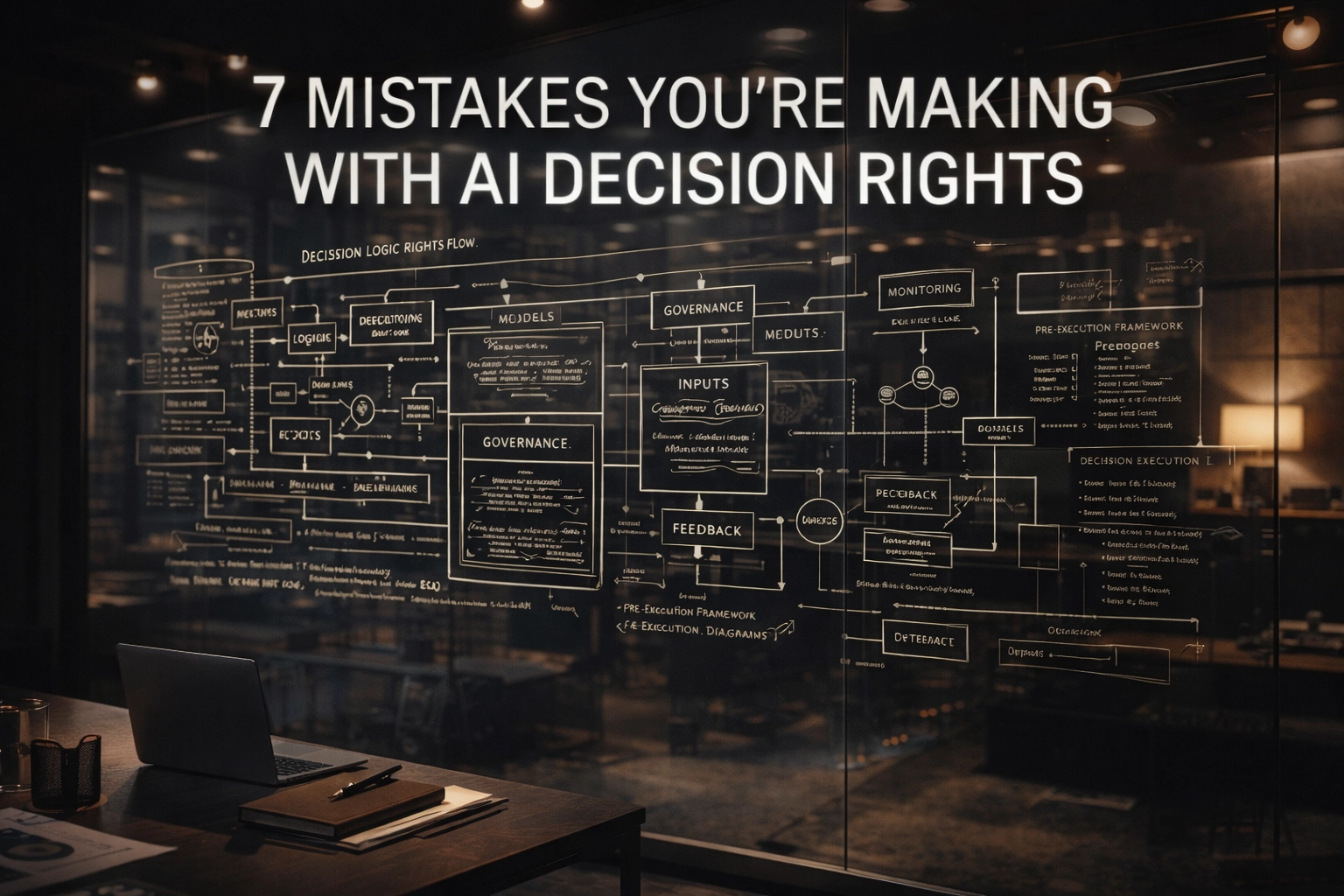
Scale is a diagnostic exercise. For a CEO leading a $1M to $50M company, scale is not about working harder. It is about the architecture of your organization. It is about how decisions are made when you are not in the room.
The introduction of AI into your workflow has created a structural vacuum. Most leaders treat AI as a high-powered software tool. This is a mistake. In a scaling environment, AI is an agent. It acts. It recommends. In many cases, it decides.
If your decision making framework does not explicitly account for AI decision rights, you are not scaling. You are accumulating hidden technical and operational debt. You are building a "ghost" org chart where accountability disappears into a black box.
Here are the seven critical mistakes you are making with AI decision rights: and the architectural shifts required to protect your scale.
1. Treating AI as a Tool Rather than a Decision Agent
Most CEOs view AI like an advanced spreadsheet. You expect it to process data and wait for a human to hit "approve."
The reality of 2026 is different. Agentic AI is already performing autonomous tasks. When an HR department deploys an AI to identify emerging talent but fails to establish who has the right to act on those recommendations, the system breaks. High-potential candidates are identified but remain un-promoted because the decision rights were never transferred from the legacy human-only process to an AI-augmented one.
The Requirement: You must stop thinking about AI usage and start thinking about AI "delegation."
The Solution: Update your Delegation Map. Every AI implementation must have a named human "Decision Owner" who is accountable for the AI’s outputs. If the AI identifies a high-potential employee, the framework must dictate exactly who receives that signal and who has the authority to trigger a transfer or promotion.

2. The Accountability Vacuum: The "Black Box" Problem
When a human makes a mistake, you have a performance review. When an AI makes a mistake: hallucinating a pricing discount or miscalculating a supply chain lead time: most organizations scramble.
The mistake is allowing "The AI did it" to become a valid explanation. This creates an accountability vacuum. If no one is responsible for the logic behind the machine, no one is responsible for the outcome.
The Requirement: Every decision made or influenced by AI must be logged and auditable.
The Solution: Install a Transparent Decision Log within your CEO Operating System™. This log must document the AI’s decision pathways and the logic used. More importantly, it must map back to a specific role’s scorecard. If the AI fails, the human role owning that function is the one who answers for the failure. Accountability cannot be delegated to code.
3. Missing Escalation Paths for AI Exceptions
Scale breaks when "exceptions" take up 80% of your time. AI is excellent at handling the 80% of standard cases but often fails spectacularly at the 20% of edge cases.
The mistake: Assuming the AI will know when it’s out of its depth. It won’t. Without clear escalation rules, the AI will continue to "decide" until a catastrophic error surfaces at the board level.
The Requirement: Hard-coded escalation triggers.
The Solution: Define "Operational Escalation Notes" for every AI-enabled department. If an AI agent encounters a customer sentiment score below a certain threshold or a financial variance above 5%, the decision right must automatically revert to a human executive. This is not a suggestion; it is a system override.
4. Over-Automation of Strategic Red Lines
Every CEO has "Red Lines": non-negotiable boundaries involving ethics, brand integrity, or market positioning. A common mistake is allowing AI to operate in areas that touch these lines without a "Human-in-the-Loop" (HITL) requirement.
If your strategic red line is "never discount the core product to hit quarterly targets," but your AI sales agent is optimized for "conversion volume," the AI will violate your principles to achieve its programmed goal.
The Requirement: A principles-based constraint layer.
The Solution: Your CEO Operating System™ must ingest your Strategic and Ethical Red Lines. These become the "guardrails" for AI decision rights. If a decision nears a Red Line, the system must freeze and require CEO or Board-level intervention.

5. Ignoring Power Dynamics and "Prompt Ownership"
In a $10M+ company, information is power. The person who controls the prompt often controls the outcome.
Mistake: Allowing fragmented AI adoption where different departments use different LLMs or data sets to make decisions. Marketing is deciding based on one set of AI-interpreted data, while Sales is using another. This creates "Decision Silos" that lead to organizational friction and conflicting priorities.
The Requirement: A centralized "Truth Layer."
The Solution: Implement Role-Based Access Controls (RBAC) for your AI decision engines. Centralize your decision making framework so that every AI agent in the company is pulling from the same "CEO Knowledge Base." This ensures that whether an AI is assisting HR or Finance, it is operating on the same fundamental logic and strategic priorities defined in your OPSP (One-Page Strategic Plan).
6. Failure to Update Scorecards and Role Charters
You cannot install AI into a 2019-era org chart.
The mistake: Adding AI tasks to an executive’s plate without updating their Decision Rights Map. This leads to "Decision Fatigue" or, worse, "Decision Abidance": where the executive simply stops questioning the AI because it’s not officially their job to do so.
The Requirement: Structural realignment.
The Solution: Every Role Scorecard in your organization must be updated to include "AI Oversight" as a core competency. If a Manager’s role is to lead a team, and that team now includes three AI agents, their scorecard must reflect their responsibility for the quality, ethics, and accuracy of those agents' decisions.
7. Static Governance in a Dynamic Market
The AI you use today will be obsolete in six months. The decision rights you grant today will be insufficient by next quarter.
The mistake: Setting AI policies as a "one and done" document. This is static governance in a dynamic world. It is the fastest way to lose your competitive edge or invite unmanaged risk.
The Requirement: A recurring operational cadence for decision rights review.
The Solution: Build a "Quarterly AI Audit" into your Operating System. This is not a technical audit; it is a leadership audit. Review which decisions were automated, which were escalated, and where the decision making framework failed to provide clarity. Adjust the rights, revoke the access, or expand the autonomy based on the data.
Protecting Your Scale: The Architectural Fix
Scale is not a result of effort; it is a result of design.
As a CEO, your job is no longer to make every decision. Your job is to design the system that makes the decisions. When AI enters the mix, the complexity of that design increases exponentially.
If you continue to treat AI as a peripheral tool, you will find yourself constantly cleaning up "AI-generated messes." You will feel overextended, your team will feel confused, and your scale will plateau as you hit the "Complexity Ceiling."
The solution is not more meetings. The solution is a more robust infrastructure. You need a system that integrates your personal leadership principles, your strategic red lines, and your organizational execution model into a single, cohesive framework.
The CEO Operating System™
At CXO Operating System, we don't provide "advice." We install infrastructure.
We help CEOs of $1M-$50M companies move from "Hustle" to "Architecture." We build the frameworks that allow you to delegate with total confidence: to both humans and AI agents.
Our process integrates:
- Your Personal Leadership Principles: So the system thinks like you.
- Strategic & Ethical Red Lines: So the organization never crosses your boundaries.
- Decision Rights Mapping: So everyone (and every machine) knows exactly what they can and cannot decide.
- CEO GPT Integration: A personalized AI that is trained on your specific operating system, not the general internet.
Stop managing the noise. Start building the system.
If you are ready to professionalize your leadership and protect your scale, let’s talk. This is not a consulting project; it is an organizational upgrade.
Apply for a Diagnostic Session with CXO Operating System