
How to Map the 'Power Map': Building a Company Intelligence Profile for HR Alignment
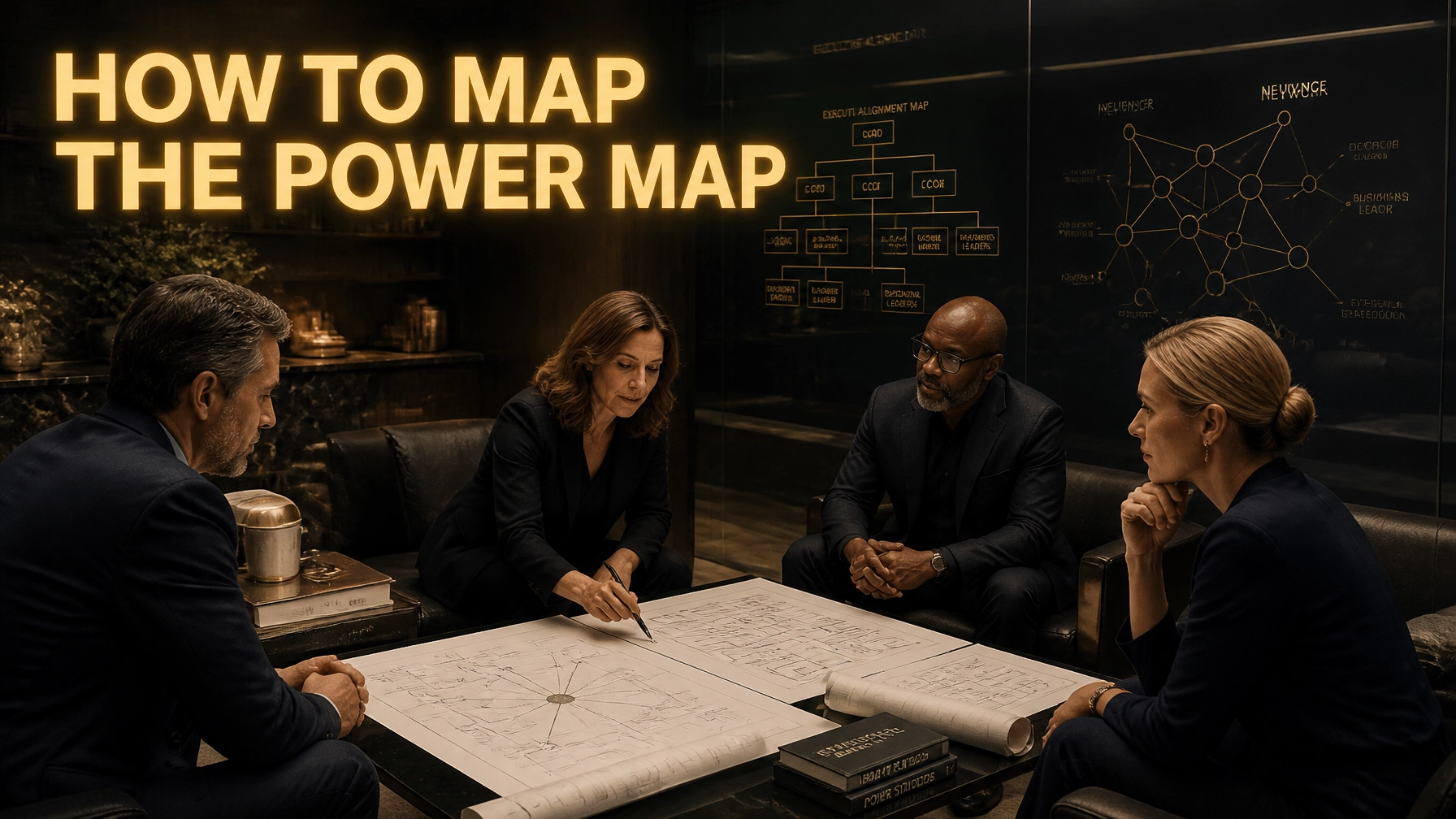
Your organizational chart is a work of fiction.
It is a two-dimensional representation of a multi-dimensional reality. It shows reporting lines, not decision flows. It shows job titles, not influence. It shows what should happen on paper, not how value is actually created in the trenches.
For HR Directors and Talent Managers, relying on a standard org chart is a recipe for strategic irrelevance. When you manage talent based on a static box-and-line drawing, you are managing ghosts. You miss the "Shadow OS": the informal network of power that actually moves the needle.
The result? Decision drag. Strategic misalignment. High-performer burnout.
To align talent with the business, you must stop looking at the org chart and start building a Company Intelligence Profile. You need to map the "Power Map."
The Diagnostic: Why Your Talent Strategy Is Failing
Most HR departments operate in a reactive loop. A leader leaves, and you scramble to fill a role. A department misses a KPI, and you suggest a training workshop.
The problem is structural. Your data is decoupled from the business's value streams.
You see the personnel, but you don't see the Decision Architecture. You don't know who the "Go-To" people are: those individuals who hold the institutional knowledge and social capital that keeps the company from grinding to a halt. When these people leave, the system breaks.
You need infrastructure, not intuition. You need a systemic way to identify where power sits, how decisions are made, and where the talent gaps are actually creating bottlenecks.

The Requirement: The Company Intelligence Profile
A Company Intelligence Profile is the diagnostic blueprint of your organization. It is the integration of business strategy, formal authority, informal influence, and technical capability.
It is not a static document. It is a living map of the organization’s operating reality.
To build it, you must move through four distinct layers of mapping:
- Value Stream Identification (What are we actually doing?)
- Formal Power Mapping (Who owns the resources?)
- Informal Power Mapping (Who has the influence?)
- Capability Layering (Do we have the skills to execute?)
This is not "HR stuff." This is business engineering.
Step 1: Identify the Value Streams (What Needs to be Powered)
Before you map people, you must map the money.
Power follows value. If you don't understand how the company generates revenue or mitigates risk, you cannot map power.
Start by distilling the CEO’s 12–36 month strategic priorities. Do not look at the mission statement; look at the Operating Plan. If the goal is "Expand into APAC," the value stream is the end-to-end flow of acquiring customers in a new territory.
Identify the critical functions within that stream. Is it Regulatory? Is it Enterprise Sales? Is it Localization?
The Infrastructure Shift: Link every Strategic Objective to a Value Stream, then to a Critical Function. This creates the spine of your Power Map. Without this, your talent strategy is just noise.
Step 2: Map Formal Power (The Official OS)
This is the layer most HR teams stop at, but it’s only the skeleton.
Formal power is defined by three things: P&L ownership, budget control, and decision rights.
Go beyond the job title. Identify the "Decision Nodes." Who has the final sign-off on the product roadmap? Who can green-light a $500k spend without a committee? These are your formal power centers.
Overlay these nodes onto your value streams. Often, you will find that the people with the formal power are not actually the people closest to the value creation. This is a bottleneck. This is where CXO Operating System begins to identify institutional drag.

Step 3: Reveal the Shadow OS (Informal Power Mapping)
This is where the real intelligence lives.
Every company has a Shadow OS. It consists of the "Bridges," the "Influencers," and the "Gatekeepers." These individuals often lack impressive titles, but they possess the "Power of No" or the "Power of Speed."
To map this, HR must use Organizational Network Analysis (ONA): either through data-driven collaboration tools or qualitative diagnostics. Ask the diagnostic questions:
- "If X left tomorrow, what processes would immediately break?"
- "Who do people go to for help when they need to bypass a formal process?"
- "Who are the culture carriers that set the morale for the entire engineering floor?"
The Diagnostic Truth: High-growth companies often suffer from "Single Points of Failure": hidden influencers who are over-indexed and on the verge of burnout because the system relies on their heroics rather than infrastructure.
Mapping the Shadow OS allows you to identify these risks before they become resignations.
Step 4: Layer the Talent Intelligence
Once you know where the power sits and how value flows, you layer in the skills.
This is not a list of certifications. This is a Capabilities-to-Roles matrix.
For every critical capability identified in Step 1 (e.g., "AI-assisted product design"), you must map:
- Current Depth: How many people actually have this skill at an expert level?
- Adjacencies: Who is 20% away from having this skill?
- External Scarcity: How hard is it to replace this person in the current market?
When you combine this with your Power Map, you get a Capability Heatmap. You can see, with clinical precision, where your strategic objectives are at risk because a critical power node lacks the necessary technical capability.

Installing the System: From Mapping to Alignment
Mapping is useless if it doesn't lead to installation.
The Company Intelligence Profile allows HR to move from a support function to a strategic architect. You are no longer "hiring for a role." You are "installing a capability into a critical power node."
1. Strategic Workforce Planning
Instead of guessing headcount, you use the Power Map to run scenarios. If the board demands a 20% increase in output, you can pinpoint exactly which value streams lack the "Bridges" or "Decision Nodes" to handle the load. You build, buy, or borrow based on the map, not the budget.
2. Succession Infrastructure
Traditional succession planning is a beauty contest. Systemic succession planning is about node redundancy. For every critical node on the Power Map: formal or informal: you must have a "Failover Plan." If an influencer leaves, who is the bridge? If a P&L owner moves, who has the decision architecture ready to take over?
3. Change Management as Engineering
Most change management fails because it ignores the Shadow OS. You try to push a new system through the formal org chart, but the informal influencers kill it in the breakroom. With a Power Map, you identify the "Champions" (high-influence nodes) and the "Resistors" (gatekeeper nodes). You sequence your rollout through the network of influence, not the hierarchy of titles.

The Final Reality: Systems Over Heroics
Scaling a C-Suite requires a shift from heroics to infrastructure.
When HR operates without a Company Intelligence Profile, they are forcing their executives to act like heroes: constantly jumping in to fix "people issues" that are actually structural failures.
By mapping the Power Map, you provide the CEO and the executive team with the visibility they need to lead with precision. You identify the bottlenecks before they become crises. You align the talent with the strategy with mathematical certainty.
Stop managing the org chart.
Start architecting the Operating System.
This is the transition from a Talent Manager to a Strategic Architect. It is the only way to ensure that as the company scales, the leadership infrastructure remains robust, trusted, and: above all: aligned.
The CXO Operating System™ is a bespoke infrastructure designed for CEOs, COOs, and HR leaders who refuse to settle for reactive leadership. We install the systems that allow your team to execute autonomously, so you can focus on the horizon.