
Why Your Best Managers Are Quitting: The Hidden Cost of Undocumented Leadership Logic
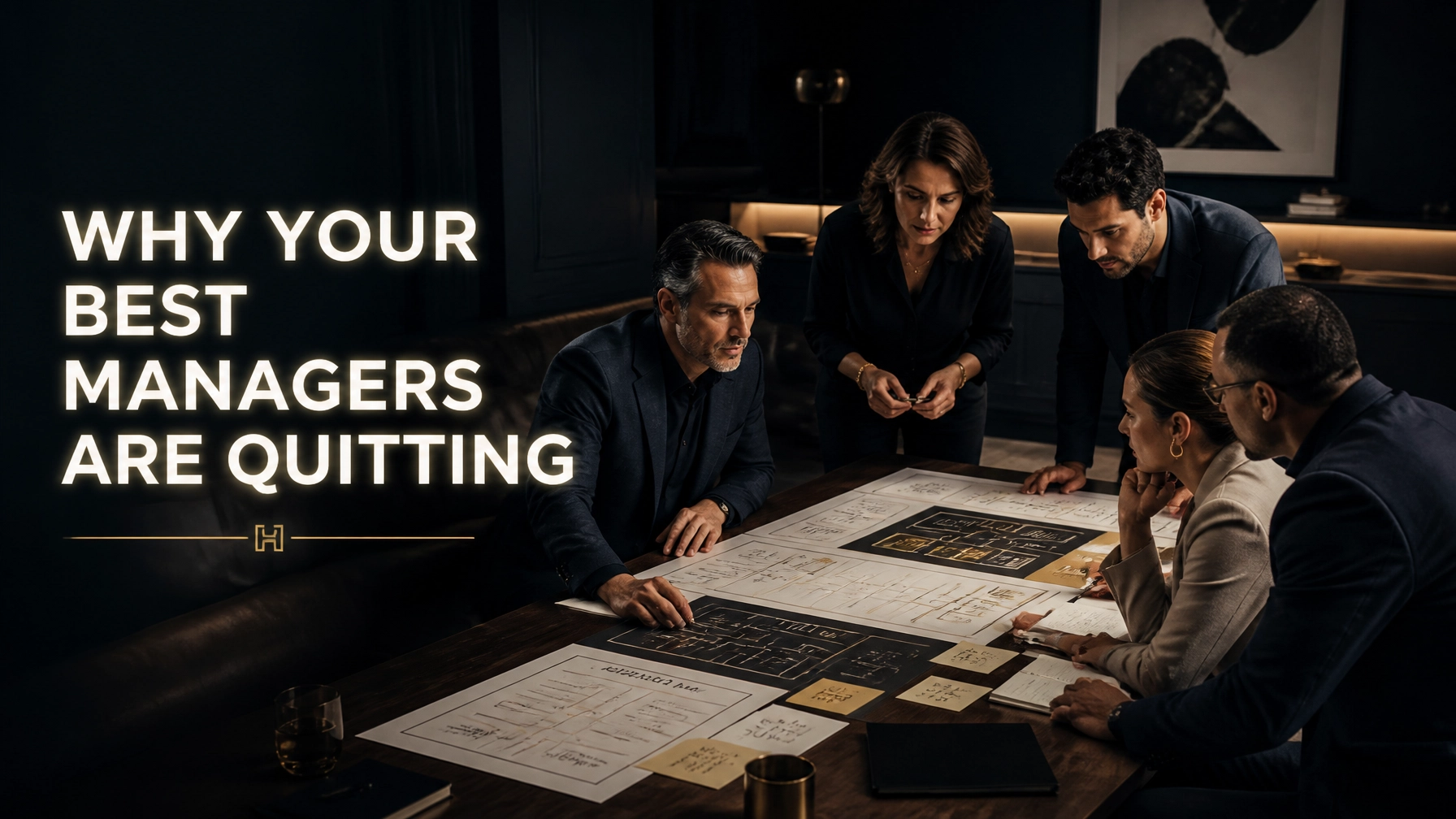
Your best managers aren’t leaving because of the salary. They aren’t leaving because of the "culture." They are leaving because they are tired of being the human duct tape holding your fragmented leadership logic together.
As an HR Director or Talent Manager, you see the attrition data. You track the exit interviews. You hear the standard refrains: "burnout," "lack of work-life balance," or "new opportunities."
These are symptoms. They are not the root cause.
The root cause is structural. It is a failure of leadership infrastructure. Most organizations operate on Undocumented Leadership Logic: a chaotic web of unwritten rules, invisible decision patterns, and tribal knowledge. In this environment, your high performers don't just manage teams; they function as the company’s informal operating system.
They are the human APIs that everyone pings to find out "how things actually get done."
This is not a leadership style. It is a system failure. And it is breaking your most valuable people.
The Diagnostic: The Hidden Burden of the "Human API"
In a systemized organization, logic is infrastructure. In a traditional organization, logic is a person.
When leadership logic is undocumented, your strongest managers are forced into three exhausting, invisible roles that drain their cognitive capacity and eventually lead to systemic collapse.
1. The Interpreter of Contradictory Rules
Every day, your managers face the "Administrative Gap." This is the space between what the company says (official policy) and what the company does (executive preference).
- Official: "We prioritize quality."
- Reality: "We need this shipped by Friday, regardless of the bugs."
Your best managers spend hours every week translating these contradictions for their teams. They absorb the friction. They perform the emotional labor of making sense of the nonsensical. This is "invisible work." It doesn't show up on a P&L, but it consumes the exact focus required for high-level strategy.
2. The Constant Knowledge Retrieval Hub
When there is no documented Decision Architecture, every edge case becomes an escalation.
- "Can we grant this exception?"
- "What’s the precedent for this client?"
- "Is this level of risk acceptable?"
Because the logic isn't written down, the manager becomes the only source of truth. They are interrupted every 15 minutes by pings, emails, and "quick questions." They aren't leading; they are serving as a manual search engine for undocumented processes.
3. The Systemic Shock Absorber
Because these managers care about the mission, they buffer their teams from the volatility of the C-Suite. They "work around" broken systems to ensure the client stays happy. They absorb the stress of shifting priorities that haven't been properly codified.
They are the heroes. But heroes don't scale. Heroes break.

The Hidden Cost: Why Logic Attrition is Fatal
When a high-performing manager quits, HR typically calculates the cost of replacement: recruiting fees, onboarding time, and lost productivity. This is an amateur calculation.
The real cost is Logic Attrition.
When that manager walks out the door, the unrecorded logic that kept your system functioning walks out with them. The "Human Operating System" just crashed, and you didn't have a backup.
The Focus Drain
Undocumented logic creates endless micro-consulting. If a manager is the only one who knows how to handle a specific trade-off, they must be present for every decision related to that trade-off. This creates a bottleneck. Decisions slow down. Execution drags. The organization loses its kinetic energy.
Quality Erosion
Without a shared decision framework, consistency is impossible. Two different managers will handle the same grievance, the same budget request, or the same client conflict in two completely different ways. This creates "manager shopping" among employees and erodes trust in the organization's fairness.
The Knowledge Vacuum
The replacement manager: no matter how talented: will spend the first six months "figuring out how things really work." During this period, the team will make avoidable mistakes, re-run old experiments that failed years ago, and escalate basic issues to senior leadership. You aren't just paying for a new hire; you are paying for the reconstruction of a lost logic map.

The Requirement: Shifting from Heroics to Infrastructure
To stop the bleeding, HR and Talent Managers must stop looking for "better leaders" and start building "better systems." You do not need more leadership training; you need Decision Architecture.
The goal is to move the company's intelligence out of the heads of individuals and into the CXO Operating System™.
Principle over Procedure
Most companies attempt to fix this with 300-page SOP manuals that nobody reads. That is not infrastructure; that is clutter.
Infrastructure is a set of Decision Principles.
- "We prioritize long-term brand equity over short-term quarterly gains."
- "Exceptions to [Policy X] are granted only if the lifetime value of the customer is >$50k."
When these principles are documented and socialized, you empower the manager to make the call without needing to "know" the unwritten rules. You reduce their cognitive load. You give them back their time.
The Power of the Private Decision Architecture
The CXO Operating System™ focuses on capturing the "Leadership Logic" of the executive team. This includes:
- Ethical and Strategic Red Lines: What will we never do?
- Escalation Rules: What specifically requires executive sign-off?
- The "Power Map": How are cross-functional blockers actually cleared?
By surfacing these hidden rules, you transform the organization from a collection of "heroes" into a scalable machine.
The Solution: Installing the CXO Operating System™
If you want to retain your best talent, you must give them a sustainable environment. You must provide them with the tools to lead without burning out. This is not a "soft skill" initiative. It is a hard-coded operational upgrade.
1. Surface the Hidden Logic
Run a diagnostic on your high-turnover departments. Ask the managers: "What are the 5 decisions you are pulled into every week that should be handled by your team?" The answers are your first logic gaps. Document the criteria for those decisions immediately.
2. Codify the Operating Cadence
Confusion is the primary driver of manager stress. When is the meeting? What is the objective? Who has the final say? Installing a disciplined Operational Cadence: as defined by the CXO Operating System™: eliminates the "noise" of reactive leadership. It allows managers to plan their lives and their work because the system is predictable.
3. Reward System-Building, Not Firefighting
In most companies, we promote the heroes: the ones who stay late to fix the mess. This is a mistake. You are incentivizing chaos. Instead, reward the managers who document their logic so well that they become unnecessary for the day-to-day firefighting. Reward the ones who build scalable infrastructure.
The Path Forward: Architecture, Not Agility
"Agility" has become a buzzword for "undocumented chaos." Real agility requires a rigid structure. You cannot pivot a ship if the crew doesn't know who is at the helm or how the engine works.
Your best managers are quitting because they are tired of guessing. They are tired of the mental gymnastics required to navigate an undocumented system.
Stop asking them to be heroes. Start giving them an operating system.
When you install the CXO Operating System™, you aren't just improving efficiency. You are protecting your most valuable asset: your leadership talent. You are building a company that is Designed to Compound: where value is added layer by layer, supported by a structure that doesn't rely on the personal heroics of a few overextended individuals.
The choice is simple: Continue to replace broken heroes, or build a system that scales.
Ready to Install a System That Scales?
The CXO Operating System™ is a proprietary framework designed for CEOs and executive teams who are ready to move beyond reactive leadership. We help organizations codify their leadership logic, align their teams, and build the infrastructure required for compound growth.